

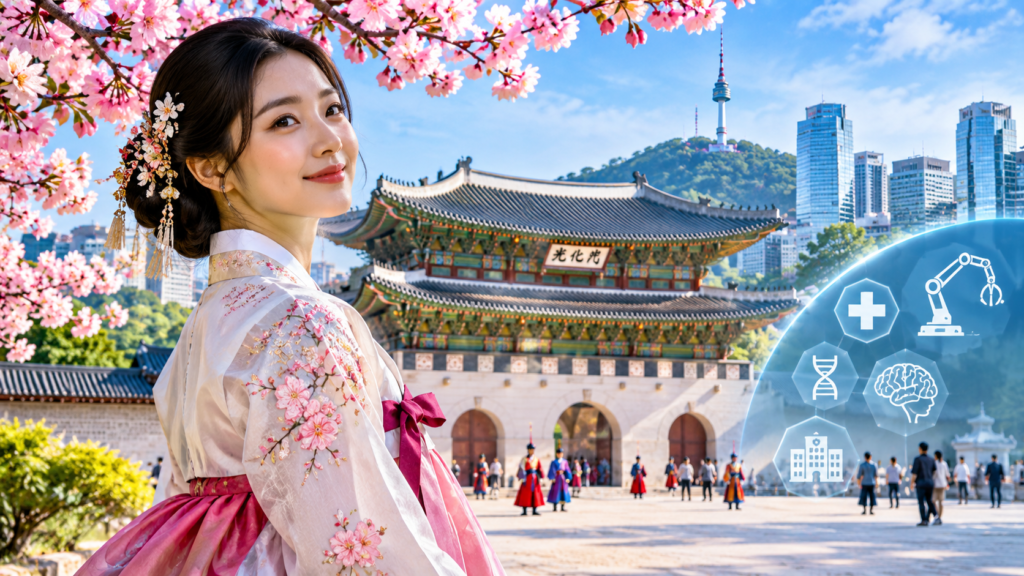
South Korea — Advanced Healthcare, Medical Innovation & Recovery
Discover specialist healthcare, medical innovation, cosmetic and reconstructive surgery, and recovery experiences in one of Asia’s most dynamic destinations.
Discover South Korea
South Korea offers an unusual combination of advanced healthcare, technological innovation, centuries-old cultural traditions and modern international travel infrastructure.
From the specialist hospitals of Seoul to the coastal attractions of Busan and the natural landscapes of Jeju Island, visitors encounter a country where modern medical services exist alongside a distinctive cultural heritage.
For international patients, South Korea provides opportunities to explore specialist consultations, elective procedures, health screening and rehabilitation programmes.
At Glowcations Asia, our focus is on helping patients understand their options, identify appropriately qualified healthcare providers and plan for treatment, recovery and follow-up care.
Our South Korea destination guide brings together medical information, practical travel considerations and the cultural experiences that make the country distinctive.
1. South Korea’s International Healthcare Sector
South Korea has developed a substantial international healthcare sector supported by specialist hospitals, medical technology companies and government programmes for overseas patients.
Its healthcare services include:
- Specialist hospital consultations and multidisciplinary treatment
- Cancer diagnosis and treatment
- Cardiovascular and orthopaedic surgery
- Neurosurgery and neurological rehabilitation
- Plastic and reconstructive surgery
- Dermatology and aesthetic medicine
- Preventive health screening
- Robotic-assisted and image-guided surgery
International patients can explore registered providers through Medical Korea, the official healthcare information platform supported by the Korea Health Industry Development Institute.
The Korean government maintains a registration system for medical institutions serving foreign patients, together with a separate accreditation programme.
Patients should understand that registration, accreditation and a specialist’s individual qualifications are different matters, each requiring appropriate verification.
2. Seoul — The Centre of Specialist Healthcare
Seoul is South Korea’s principal centre for international medical services.
The capital combines major teaching hospitals, specialist medical centres, private clinics and an extensive transport network.
Major Specialist Hospitals
Several of Seoul’s prominent hospitals offer international patient services, including:
Seoul National University Hospital — A major university hospital providing specialist medical and surgical services.
Asan Medical Center — A large tertiary hospital associated with complex specialist treatment and multidisciplinary care.
Samsung Medical Center — A major medical institution offering specialist hospital services and international patient support.
These hospitals are included as examples of established healthcare institutions, not as individually assessed Glowcations Asia partners.
Treatment availability, eligibility, costs and international patient arrangements should be confirmed directly with each provider.
3. Plastic and Reconstructive Surgery
South Korea has developed an internationally recognised cosmetic surgery sector, particularly in Seoul.
Procedures offered by specialist clinics may include:
- Facelift and neck-lift surgery
- Eyelid surgery
- Rhinoplasty
- Facial contouring
- Breast surgery
- Reconstructive procedures
For international patients, choosing a surgeon should involve more than reviewing promotional photographs or online testimonials.
Important considerations include the surgeon’s qualifications, relevant procedural experience, the clinic’s operating licence, anaesthesia arrangements, emergency facilities and postoperative care.
V.LIF Plastic Surgery — A Clinic of Interest
One Seoul clinic of interest is V.LIF Plastic Surgery, whose international website focuses on facial rejuvenation and related cosmetic procedures.
Its services may be relevant to patients researching facelift and facial ageing treatments.
Glowcations Asia has not yet independently verified V.LIF’s current licensing, individual surgeon credentials, clinical outcomes or international patient arrangements.
The clinic is therefore mentioned for further research rather than presented as a recommended or approved healthcare partner.
We intend to assess suitable providers before developing individual clinic profiles or patient referral pathways.
4. Dermatology and Aesthetic Medicine
South Korea is also known internationally for dermatology, skincare research and non-surgical aesthetic services.
Clinics may offer treatments involving lasers, skin resurfacing, pigmentation management, scar treatment and other dermatological procedures.
Some treatments are medically indicated, while others are elective cosmetic services.
Patients should establish whether a proposed procedure is appropriate for their skin condition, whether the practitioner is qualified to perform it and what complications may occur.
The availability of advanced equipment does not guarantee that a treatment is suitable or effective for every patient.
5. Medical Robotics and Advanced Surgical Technologies
South Korea is an important participant in the development and application of advanced medical technologies.
Robotic-assisted surgery, computer-guided procedures, advanced imaging and surgical navigation systems are used in selected specialist settings.
These technologies may support surgical precision and procedural planning, although their advantages depend on the procedure, clinical evidence and operator experience.
Robotic-assisted surgery remains under the control of trained medical professionals.
For patients, the most important questions concern clinical outcomes, specialist qualifications and the suitability of the technology for their particular condition.
Explore our related guide: Medical Robotics & Advanced Surgical Technologies in Asia, available through the Glowcations Asia Healthcare menu.
6. Cancer Care and Precision Medicine
South Korea’s major hospitals provide specialist oncology services, including multidisciplinary assessment, surgery, systemic treatments and radiotherapy.
Some centres also participate in clinical research involving molecular diagnostics, precision medicine and emerging cancer treatments.
Patients considering treatment abroad should request a review of their existing diagnosis, pathology, imaging and treatment history before travelling.
Treatment recommendations should be based on an individual clinical assessment rather than general promotional claims.
Where appropriate, international patients should also arrange communication between their overseas specialist and their treating doctors at home.
7. Rehabilitation and Extended-Stay Recovery
Recovery planning is an important part of medical travel.
Depending on the treatment, patients may require postoperative monitoring, wound care, physiotherapy, rehabilitation or follow-up consultations.
Accommodation should be selected according to medical needs rather than tourism preferences alone.
Important considerations include:
- Distance from the treating hospital or clinic
- Accessibility and mobility requirements
- Availability of appropriate nursing or rehabilitation services
- Transport to follow-up appointments
- Language assistance
- Emergency arrangements
- Medical clearance before flying home
Extended stays may be appropriate for selected patients, but the duration should be determined by their treating specialist.
8. Beyond Seoul — Busan and Jeju Island
Busan — Coastal South Korea
Busan combines urban healthcare services with coastal scenery, beaches, cultural attractions and an established hospitality sector.
Its waterfront areas, markets and historic neighbourhoods provide opportunities for visitors to explore another side of South Korea.
For patients requiring ongoing treatment, travel outside Seoul should be planned around clinical appointments and recovery requirements.
Jeju Island — Nature and Rest
Jeju Island is known for volcanic landscapes, coastal walking routes, gardens and a quieter atmosphere than South Korea’s largest cities.
It may appeal to visitors seeking rest or an extended stay after completing medical treatment.
However, travel to Jeju should not be treated as a substitute for supervised postoperative recovery or rehabilitation.
Patients should obtain medical clearance before undertaking domestic flights, long journeys or strenuous activities.
For official destination information, visit Visit Korea.
9. Korean Culture, Heritage and Hospitality
South Korea’s cultural heritage adds another dimension to the visitor experience.
In Seoul, historic royal palaces, traditional neighbourhoods and museums offer an introduction to the country’s history.
Gyeongbokgung Palace, traditional hanbok clothing, Korean cuisine and historic architecture provide a striking contrast with the capital’s modern skyline.
Visitors may also explore Korean tea traditions, craft markets and cultural performances.
For medical travellers, cultural activities should be chosen according to individual health, mobility and recovery requirements.
The aim is to make an extended stay comfortable and meaningful without compromising medical care.
10. Planning Medical Travel to South Korea
Before arranging treatment, international patients should consider several practical matters.
Medical assessment: Obtain an independent review of the proposed treatment, expected benefits, alternatives and risks.
Provider verification: Check hospital registration, specialist qualifications and the availability of suitable facilities.
Treatment costs: Request a written quotation identifying consultations, investigations, surgery, anaesthesia, hospital stays, medicines and follow-up arrangements.
Travel requirements: Confirm current entry and visa conditions through official Korean government information.
Insurance: Check whether your insurance covers planned medical treatment and complications. Many standard travel insurance policies exclude elective procedures.
Recovery arrangements: Allow sufficient time for follow-up appointments and obtain medical clearance before returning home.
Continuity of care: Arrange access to clinical records and communication with healthcare professionals in your home country.
The Medical Korea official website provides information about registered medical institutions and international patient services.
11. How Glowcations Asia Can Assist
Glowcations Asia is developing a network of healthcare information and international patient resources across Asia.
Our South Korea programme will progressively include independently reviewed hospital and clinic information, specialist treatment guides, recovery accommodation and practical travel resources.
We aim to help patients:
- Understand available treatment pathways
- Identify questions to ask healthcare providers
- Compare information from appropriately qualified specialists
- Consider treatment and recovery requirements
- Plan for continuity of care after returning home
We do not diagnose medical conditions, prescribe treatment or guarantee clinical outcomes.
Any future provider relationship will be subject to appropriate verification, transparency and patient-first standards.
Discover South Korea with Glowcations Asia
Our Healthcare and Editorial Network
Glowcations Asia forms part of a growing network of healthcare information and independent editorial resources across Asia.
Medical Tourism Vietnam — International Patient Information
Established in 2011, Medical Tourism Vietnam provides information for international patients exploring healthcare services in Vietnam and selected specialist medical programmes in China.
Its patient-first approach emphasises informed treatment decisions, appropriately qualified providers, transparent quotations and continuity of care.
Visitors considering healthcare in South Korea may also find it useful to compare treatment pathways and recovery arrangements with those available in Vietnam.
Explore Medical Tourism Vietnam for additional information.
Hanoi Trading Post — Asian Healthcare, Culture and Society
Hanoi Trading Post provides independent editorial coverage of Asian culture, history, society and emerging healthcare developments.
Its reporting examines both the opportunities and challenges associated with medical innovation, including the importance of clinical evidence, patient safety and ethical oversight.
One recent example is China–Russia Spinal Cord Transplant: Medical Breakthrough or Experimental Frontier?, which examines an experimental neurological procedure and the questions surrounding its clinical significance.
Although the research discussed in that article is not a South Korean treatment programme, it illustrates the importance of distinguishing emerging medical research from established clinical care.
Together, Glowcations Asia, Medical Tourism Vietnam and Hanoi Trading Post provide complementary perspectives on healthcare, medical travel and developments across the region.
South Korea offers an intriguing combination of medical innovation, specialist healthcare, modern cities and traditional cultural experiences.
From the operating theatres of Seoul to the coastal landscapes of Busan and Jeju, the country provides opportunities for international visitors seeking healthcare information and carefully planned recovery experiences.
Glowcations Asia will continue expanding this destination guide as additional providers, medical programmes and reliable resources are assessed.
Our commitment remains consistent: informed patients, appropriately qualified healthcare providers and responsible medical travel.
Medical Information Notice
This page provides general educational and destination information. It does not constitute medical advice or an endorsement of any named hospital or clinic. Healthcare availability, licensing, costs and clinical suitability must be verified directly with the relevant provider. Patients should obtain independent medical advice before arranging treatment abroad.