

Medical Robotics & Advanced Surgical Technologies in Asia
Exploring robotic-assisted surgery, functional neurosurgery, neurological rehabilitation and emerging medical technologies across Asia.
The Future of Surgery Is Changing
Across Asia, advances in medical robotics, precision imaging, computer-assisted surgery and neurological technologies are changing how specialists diagnose, plan and perform complex medical procedures.
Hospitals and research institutions in China, Japan, South Korea, Singapore and other Asian healthcare centres are contributing to these developments.
For international patients, these innovations may offer additional treatment options, greater surgical precision and new approaches to managing complex medical conditions.
However, not every emerging technology represents an established medical treatment.
At Glowcations Asia, our purpose is to help patients understand the technologies, evaluate the evidence and identify appropriately qualified healthcare providers.
1. Robotic-Assisted Surgery
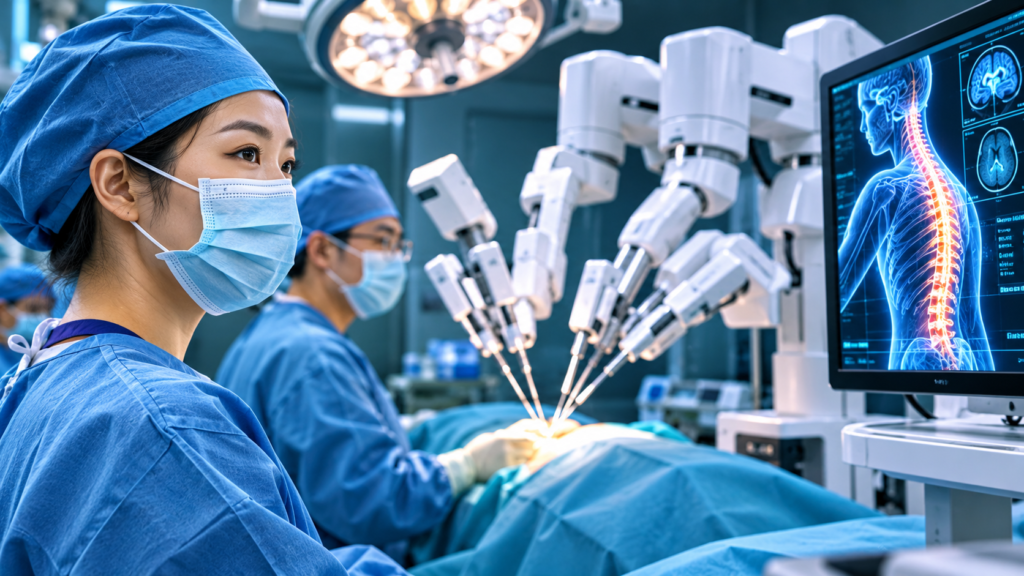
Robotic-assisted surgery enables trained surgeons to control specialised instruments through computer-assisted systems.
Depending on the procedure, these systems may provide magnified three-dimensional imaging, enhanced instrument movement and access to difficult anatomical locations.
Applications include selected procedures in:
- Urology and prostate surgery
- Gynaecological surgery
- Colorectal and gastrointestinal surgery
- Thoracic surgery
- Selected head and neck procedures
Importantly, robotic surgery does not mean that a robot independently performs the operation. The surgeon remains responsible for controlling the procedure.
Robotic assistance is not automatically superior to conventional surgery. The appropriate approach depends on the patient’s condition, the surgeon’s experience, the available evidence and the risks of each option.
Further information: US Food and Drug Administration — Computer-Assisted Surgical Systems.
2. Functional Neurosurgery and Precision Neurological Treatment
Functional neurosurgery uses specialised techniques to modify or regulate activity in selected areas of the nervous system.
Two important technologies are Deep Brain Stimulation (DBS) and MRI-guided Focused Ultrasound (MRgFUS).
Deep Brain Stimulation (DBS)
DBS involves implanting electrodes in carefully selected brain regions. These connect to an implanted stimulation device that delivers controlled electrical impulses.
For appropriately selected patients, DBS may help manage symptoms associated with Parkinson’s disease, essential tremor and certain forms of dystonia.
DBS requires specialist assessment, surgery, device programming and continuing follow-up.
MRI-Guided Focused Ultrasound (MRgFUS)
MRgFUS uses focused ultrasound energy guided by magnetic resonance imaging to treat selected neurological conditions without a conventional surgical incision.
It has clinical applications for certain movement disorders, particularly appropriately selected patients with medication-resistant tremor.
Unlike DBS, focused ultrasound treatment does not generally involve an implanted stimulation device.
The two procedures are not interchangeable, and patient suitability must be determined by an experienced neurological team.
Explore: Functional Neurosurgery in China — Medical Tourism Vietnam.
Clinical guidance: NICE — MRI-Guided Focused Ultrasound for Tremor in Parkinson’s Disease.
3. Rehabilitation Robotics and Assisted Mobility
Medical robotics is also contributing to neurological rehabilitation.
Robotic gait-training devices, powered exoskeletons and upper-limb rehabilitation systems can support structured movement training for selected patients.
These technologies may be considered in rehabilitation programmes for people recovering from stroke, spinal cord injury and certain neurological conditions.
Potential benefits include repetitive movement practice, monitoring of rehabilitation progress and support for individualised therapy.
Nevertheless, results vary according to the patient’s condition, injury severity, rehabilitation programme and treatment goals.
Robotic rehabilitation should complement appropriately supervised multidisciplinary care rather than replace it.
Further reading: World Health Organization — Rehabilitation for Neurological Conditions.
4. Spinal Cord Repair and Experimental Neurosurgery
One of the most challenging areas of neurological research concerns the repair of severely damaged spinal cord tissue.
Researchers are investigating approaches involving nerve regeneration, biomaterials, electrical stimulation, neural interfaces and experimental transplantation.
In October 2026, Chinese and Russian surgeons reported performing an experimental spinal cord transplant procedure in Moscow.
Although the operation attracted international attention, publicly available evidence had not established that the procedure restored meaningful neurological function.
This distinction is essential.
An experimental operation is not necessarily a clinically effective treatment.
Glowcations Asia will monitor such developments while distinguishing research findings from treatments supported by reliable clinical evidence.
Read our editorial analysis: China–Russia Spinal Cord Transplant: Medical Breakthrough or Experimental Frontier? — Hanoi Trading Post.
5. Artificial Intelligence, Surgical Navigation and Precision Medicine
Artificial intelligence and advanced imaging are increasingly being investigated and incorporated into medical planning and decision-support systems.
Potential applications include:
- Analysis of medical images
- Surgical navigation and anatomical mapping
- Treatment planning
- Intraoperative monitoring
- Rehabilitation assessment and progress tracking
These technologies can support clinical decision-making, but their reliability depends on validation, appropriate regulation, data quality and professional oversight.
For patients, the important question is not simply whether a hospital uses artificial intelligence or robotic equipment.
It is whether the technology improves outcomes for the particular condition being treated.
6. Advanced Medical Technology Across Asia
Glowcations Asia will progressively examine developments in major Asian healthcare destinations.
China — Functional neurosurgery, medical robotics, neurological research, precision medicine and advanced specialist programmes.
Japan — Precision surgical systems, medical robotics and neurological rehabilitation technologies.
South Korea — Robotic-assisted surgery, advanced imaging and specialist hospital technology.
Singapore — Technology-supported specialist care, clinical research and integrated multidisciplinary services.
Vietnam — Developing applications of robotic-assisted surgery, modern imaging and advanced hospital technologies.
Individual hospitals, programmes and clinical capabilities will be featured as their qualifications, facilities, available procedures and patient pathways are verified.
7. What International Patients Should Consider
Access to advanced equipment does not, by itself, guarantee better treatment.
Before choosing a hospital or specialist, patients should consider:
- Whether the procedure is established or experimental
- The specialist’s qualifications and relevant experience
- The hospital’s licensing and clinical capabilities
- Evidence of benefits, limitations and complications
- Available alternatives, including non-surgical treatment
- Total costs and likely recovery requirements
- Postoperative rehabilitation and continuity of care
- Communication with the patient’s treating doctors at home
Patients considering experimental interventions should also request details of research ethics approval, informed consent, clinical trial registration where applicable and long-term follow-up arrangements.
8. How Glowcations Asia Supports Informed Decisions
Glowcations Asia aims to connect reliable medical information with appropriately qualified healthcare providers and practical international patient support.
Our approach is patient-first.
We do not diagnose medical conditions, prescribe treatments or guarantee outcomes.
Where appropriate, we help patients understand available healthcare pathways, identify questions to ask providers and consider the practical requirements of treatment and recovery abroad.
Our coverage of medical robotics and advanced surgical technologies will continue to expand as new evidence, specialist programmes and verified healthcare partnerships become available.
Looking Ahead
Medical robotics and advanced surgical technologies represent an important area of healthcare innovation across Asia.
Some technologies are already part of established specialist practice. Others remain in early clinical research.
The challenge is to recognise genuine progress without allowing technological excitement to replace scientific evidence.
For international patients, informed decisions must always come before medical promises.
Glowcations Asia — Connecting advanced healthcare, informed patients and responsible international medical pathways.
Editorial Notice
This page provides general educational information. It is not medical advice or a recommendation to undergo any particular procedure. The availability, regulatory status and suitability of treatments vary by country, hospital and patient. Independent specialist assessment is essential before making treatment decisions.