

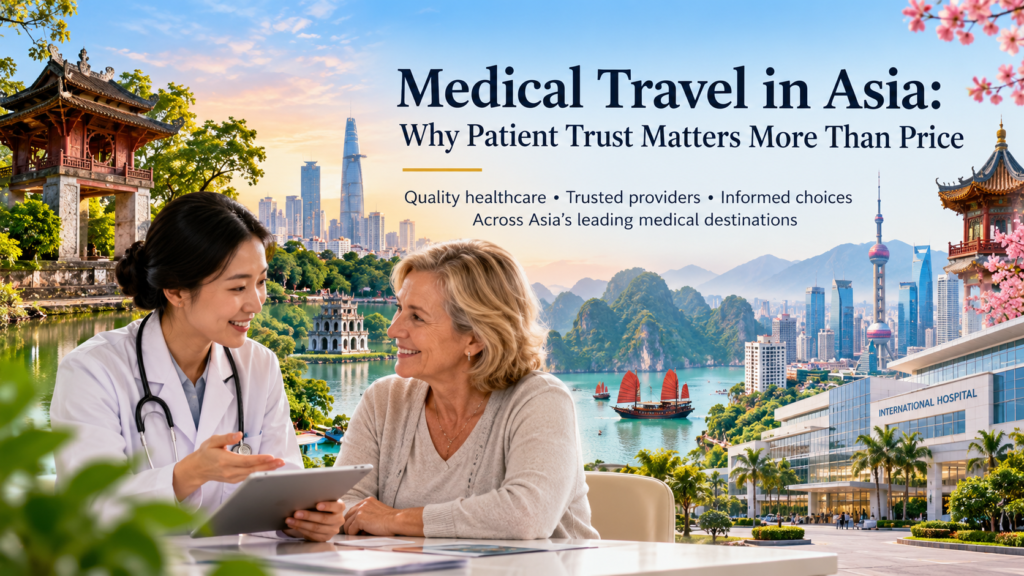
Medical Travel in Asia: Why Patient Trust Matters More Than Price
From Vietnam’s developing international healthcare sector to China’s advanced specialist services, Asia offers diverse medical treatment opportunities. But responsible medical travel begins with informed decisions, qualified providers and continuity of care.
Asia is increasingly attracting international attention for its healthcare services. Across the region, hospitals and specialist medical centres offer everything from dental treatment and elective surgery to complex cancer care, advanced diagnostics and rehabilitation.
For international patients, this growing range of services presents opportunities—but also important decisions.
The question is no longer simply where treatment costs less. It is where patients can obtain appropriate medical care, reliable information and the support they need before, during and after treatment.
At Glowcations Asia, we believe healthcare should come first. Travel, accommodation, wellness and recovery arrangements should support the patient’s medical needs rather than determine the treatment chosen.
Asia’s Healthcare Landscape Is Changing
International medical travel is often associated with lower treatment costs. Although affordability remains important, it is only one consideration.
Different Asian destinations have developed particular healthcare capabilities, supported by varying combinations of public hospitals, private healthcare groups, specialist centres, medical technology and international patient services.
Vietnam has attracted attention for dental services, elective procedures and developing specialist hospital capabilities.
China offers advanced medical research and specialist healthcare services, including precision diagnostics, oncology and functional neurosurgery at selected institutions.
Singapore is recognised internationally for its specialist healthcare infrastructure, while countries such as Thailand, Malaysia, India, Japan and South Korea offer their own combinations of established medical services and specialist expertise.
These distinctions matter.
There is no single “best” healthcare destination for every patient. The appropriate choice depends on the medical condition, proposed treatment, provider qualifications, clinical evidence, cost and follow-up requirements.
A destination’s reputation should never substitute for evaluating the individual hospital and treating specialist.
Vietnam: Growing Recognition and the Importance of Patient Trust
Vietnam provides a useful example of how Asia’s healthcare landscape is evolving.
A recent VietNamNet report, “Why foreigners are crossing oceans for medical treatment in Vietnam”, highlighted international patients receiving specialist treatment in Vietnamese hospitals, including complex surgical procedures.
This growing recognition is encouraging.
However, international confidence must be supported by more than individual examples of successful treatment.
Patients need access to verifiable information about healthcare providers, specialist qualifications, treatment risks, costs and postoperative arrangements.
These issues were examined in a recent Hanoi Trading Post editorial, “Vietnam’s Medical Tourism Opportunity: International Recognition Must Be Matched by Patient Trust”.
For patients considering Vietnam specifically, Medical Tourism Vietnam, established in 2011, provides information and international patient coordination support.
Its newly published guide, “Considering Medical Treatment in Vietnam? What International Patients Should Know”, explains how to assess healthcare providers, compare treatment quotations and prepare for recovery and follow-up care.
Vietnam’s developing healthcare reputation illustrates a broader regional challenge: attracting international patients is only the beginning. Maintaining their confidence requires transparency, patient safety and reliable clinical support.
China: Advanced Specialist Medicine and Healthcare Innovation
China’s healthcare sector presents a different set of considerations for international patients.
Selected Chinese hospitals and specialist centres are involved in advanced oncology, molecular diagnostics, cellular therapies, precision medicine and functional neurosurgery.
Examples include molecular profiling to help identify clinically relevant tumour characteristics, specialist multidisciplinary cancer consultations and selected neurosurgical procedures for movement disorders.
Research into patient-derived tumour organoids and cellular immunotherapies also demonstrates the pace of medical innovation.
However, patients must distinguish carefully between established clinical treatments, specialist procedures available only to selected patients, and investigational therapies offered through regulated clinical trials.
A promising research result does not automatically mean that a treatment is proven, approved or appropriate for an individual patient.
For complex conditions such as cancer, treatment decisions should be guided by qualified specialists who can explain the available evidence, eligibility criteria, expected benefits, risks and reasonable alternatives.
International patients should also establish whether the proposed treatment is standard care, an approved intervention for their condition or part of a clinical trial.
Clinical trial participation may involve specific eligibility requirements, research consent procedures and follow-up obligations.
Glowcations Asia aims to make these distinctions clearer as it develops its healthcare destination and specialist provider information.
Choosing Healthcare Providers Across Asia
The most important decision in medical travel is not necessarily which country to visit.
It is which healthcare team is appropriately qualified and equipped to assess and treat the patient’s condition.
Before committing to treatment, patients should seek answers to several questions:
- Is the hospital or clinic appropriately licensed for the proposed service?
- What are the treating specialist’s qualifications and relevant experience?
- What diagnostic investigations are required before treatment can be confirmed?
- Is the proposed treatment supported by appropriate clinical evidence?
- What complications are possible, and how would they be managed?
- Will the patient receive clear medical records and discharge information?
- What arrangements are available for follow-up care after returning home?
Hospital accreditation may provide useful information, but accreditation alone does not guarantee a particular outcome.
Patients should also consider whether language support is available and whether they can communicate effectively with the treating team.
A responsible healthcare provider should be prepared to explain treatment options and acknowledge uncertainty where it exists.
Understanding Treatment Costs and Financial Transparency
Treatment costs can vary substantially between countries, hospitals and individual patients.
A quotation may depend on the diagnosis, complexity of treatment, required investigations, length of admission and any additional care needed.
Patients should request a sufficiently detailed estimate and clarify which services are included.
Potential additional expenses may involve diagnostic tests, medicines, implants, anaesthesia, extended hospital admission, complications, rehabilitation and follow-up consultations.
Travel, accommodation and accompanying family members can also affect the overall cost.
A lower advertised price does not necessarily represent better value.
The most meaningful comparison is between clinically appropriate treatment plans with clearly explained inclusions, exclusions and potential additional costs.
Patients should also ask whether referral or coordination services receive payments from participating healthcare providers.
Commercial relationships should be transparent and should not prevent patients from considering alternatives.
Recovery, Wellness and Extended Stays: Understanding the Difference
Asia offers a wide range of accommodation, wellness and recovery experiences.
These may be attractive to patients who need to remain near their treating hospital after discharge.
However, it is important to distinguish medical rehabilitation from general wellness services.
Postoperative rehabilitation should follow an appropriate clinical assessment and treatment plan. Wellness activities, traditional healing practices and relaxation services should not be presented as substitutes for necessary medical treatment.
Some traditional therapies may have cultural significance or provide comfort, but claims about treating medical conditions should be assessed against appropriate clinical evidence and safety considerations.
For patients recovering from surgery or managing serious illnesses, the treating medical team should advise which activities are suitable.
Accommodation should be selected according to mobility, accessibility, proximity to medical services and the patient’s likely recovery requirements.
A comfortable extended stay can support recovery, but it cannot replace clinical follow-up.
Continuity of Care Across International Borders
One of the greatest challenges in international medical travel arises after the patient returns home.
A patient may need further diagnostic tests, medication adjustments, rehabilitation or specialist reviews.
Before travelling, patients should discuss these requirements with their existing healthcare professionals wherever possible.
They should also establish how their overseas treating team will communicate with doctors at home.
Important documentation may include discharge summaries, operative reports, pathology results, imaging records, medication instructions and recommendations for ongoing monitoring.
Patients should understand what symptoms require urgent attention and whom to contact if complications arise.
Travel insurance and medical insurance should be reviewed carefully. Many standard travel insurance policies do not cover planned overseas treatment or complications associated with elective procedures.
Continuity of care should be part of the treatment plan from the beginning—not an afterthought.
The Role of Glowcations Asia
Glowcations Asia is being developed as a regional information platform connecting international healthcare interests with Asian medical destinations, healthcare providers and appropriate travel and extended-stay services.
Its purpose is broader than promoting hospitals or tourism destinations in isolation.
We aim to help readers understand the relationship between medical treatment, provider selection, patient support, destination planning and recovery.
Healthcare providers and specialist medical services will remain central to this approach.
Our developing coverage includes Vietnam, China, Hong Kong, India, Japan, Malaysia, Singapore, South Korea and Thailand.
As the platform grows, we intend to provide clearer information about specialist healthcare capabilities, hospital services, emerging medical developments and the practical considerations involved in international treatment.
We recognise that healthcare decisions are personal and that no single destination or provider is appropriate for everyone.
Glowcations Asia does not diagnose medical conditions, prescribe treatment or guarantee clinical outcomes.
Medical decisions must remain with appropriately qualified healthcare professionals and individual patients.
Looking Beyond Price
Asia’s expanding healthcare capabilities create opportunities for international patients, hospitals and specialist medical providers.
But sustainable growth in medical travel requires more than attractive destinations and competitive quotations.
It requires credible healthcare information, appropriately qualified professionals, transparent commercial relationships, informed consent and dependable follow-up care.
For patients, the objective should never be simply to travel overseas for treatment.
It should be to obtain appropriate care, understand the risks and make informed decisions with confidence.
The future of medical travel in Asia will be shaped not only by where patients can go, but by whom they can trust.
Further Patient Information
For practical guidance on evaluating treatment options in Vietnam, read Medical Tourism Vietnam’s International Patient Guide.
For an independent perspective on Vietnam’s developing international healthcare reputation, read Hanoi Trading Post’s editorial on patient trust.
Explore Glowcations Asia for developing information on healthcare destinations, medical services and extended-stay opportunities across Asia.
About the Author
George Adams | Founder, Medical Tourism Vietnam
George Adams established Medical Tourism Vietnam in 2011 and publishes healthcare and regional commentary through Hanoi Trading Post.
His work focuses on international patient information, responsible healthcare coordination, provider transparency and the development of patient-centred medical travel services across Asia.
He is not a medical practitioner. Clinical assessment and treatment decisions remain the responsibility of qualified healthcare professionals.
Medical disclaimer: This article is for general educational purposes and does not constitute medical advice. Healthcare services, treatment availability, regulatory approvals and individual patient eligibility vary between providers and jurisdictions. Patients should consult appropriately qualified medical professionals before making treatment or travel decisions.

Pingback: GoBroad Neuro-Oncology Center in Beijing
Pingback: GoBroad ESMO 2026: New Cancer Treatment Research